Canadians Sacrificing Retirement for a Home? FHSA and HBP Explained
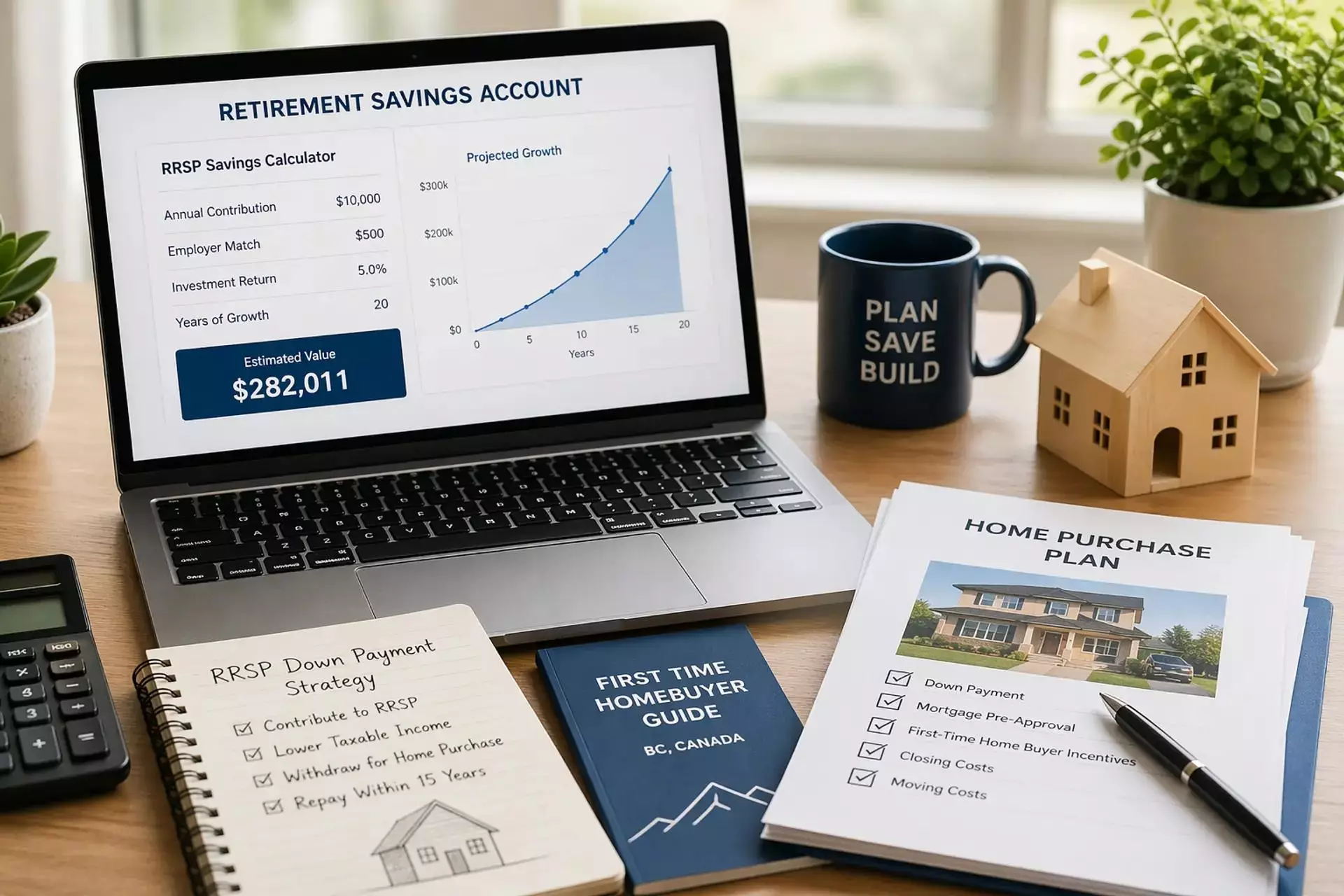
Buying a home is one of the biggest financial milestones in a Canadian’s life. But what happens when the dream of homeownership starts competing with the money you need for retirement?
With home prices, mortgage payments, closing costs and everyday expenses putting pressure on household budgets, some Canadians may feel they have to choose between owning a home today and retiring comfortably tomorrow.
The good news? First-time home buyers in Canada may have access to two powerful government programs that can help them save for a down payment without unnecessarily sacrificing their long-term financial future: the First Home Savings Account (FHSA) and the Home Buyers’ Plan (HBP).
For buyers in the Greater Toronto Area (GTA), Barrie, Angus and Simcoe County, understanding how these programs work could make a meaningful difference in their home-buying strategy.
Let’s break down the numbers, the rules, the potential benefits and the mistakes to avoid.
1. Why are Canadians willing to sacrifice retirement savings for a home?
For many households, buying a home is about more than owning property. It can represent stability, independence, a place to raise a family and a long-term investment.
But saving a down payment has become a significant challenge.
Potential buyers may be tempted to:
-
Withdraw money from their RRSPs beyond what is strategically necessary.
-
Reduce or stop contributions to their retirement investments.
-
Delay retirement savings for several years.
-
Use nearly all their cash for a down payment and closing costs.
-
Buy a home that leaves little room for emergencies or future mortgage payments.
The danger is that a home purchase can improve one part of your financial picture while weakening another.
Your home is an asset, but it does not automatically replace a diversified retirement portfolio. Home equity can be valuable, yet accessing it later may require selling, refinancing or borrowing against the property.
The goal should be to buy a home without putting your future financial security at unnecessary risk.
2. The numbers: how difficult is saving for a home in Canada?
Recent Canadian housing research highlights the challenge facing aspiring homeowners.
4.4 years
Average time homebuyers took to save for a down payment in CMHC's 2026 Mortgage Consumer Survey, up from 3.4 years in 2025.
CMHC
51%
Of first-time buyers identified savings as the largest component of their down payment in the 2026 CMHC survey.
CMHC
62%
Of Canadians viewed homeownership as a key part of their retirement strategy in HOOPP's 2025 Canadian Retirement Survey.
These findings reveal a financial balancing act: Canadians see homeownership as a potential source of retirement security, yet getting into the housing market can take years of saving.
The answer isn't necessarily to postpone buying indefinitely. It's to make better use of the savings and tax advantages available before tapping retirement funds unnecessarily.
3. What is the FHSA, and why could it be a game-changer?
The First Home Savings Account (FHSA) was designed to help eligible Canadians save for their first qualifying home with valuable tax benefits.
Here's what makes it attractive.
Annual contribution limit
$8,000
Lifetime contribution limit
$40,000
Unused participation room can carry forward, subject to the CRA's rules. Generally, carry-forward room is limited to $8,000, so opening an FHSA earlier can matter.
Three major FHSA benefits
1. Tax-deductible contributions
Eligible contributions can generally be deducted from taxable income, potentially reducing your income tax bill.
For example, if you contribute $8,000 and your marginal tax rate is 30%, the potential tax reduction could be approximately $2,400. Your actual result depends on your tax situation and available deductions.
2. Tax-free qualifying withdrawals
If you meet the conditions for a qualifying withdrawal, you can withdraw the money and investment growth tax-free to purchase an eligible home.
3. You don't have to repay a qualifying withdrawal
Unlike the Home Buyers' Plan, qualifying FHSA withdrawals do not need to be repaid.
That last point is important: you can use the FHSA to build a down payment without creating a future repayment obligation.
Read the official CRA guide to the FHSA to confirm eligibility and withdrawal conditions.
4. The Home Buyers' Plan: use your RRSP strategically
What if you've already accumulated money in a Registered Retirement Savings Plan (RRSP)?
The Home Buyers' Plan (HBP) allows eligible buyers to withdraw money from their RRSPs to buy or build a qualifying home.
Under current federal rules, the maximum withdrawal is $60,000 per eligible individual. Qualifying buyers can potentially use both the FHSA and HBP for the same home, provided they satisfy the conditions for each program.
How does the HBP work?
-
You withdraw eligible funds from your RRSP under the program rules.
-
You use the money toward a qualifying home purchase or build.
-
You repay the amount to your RRSP over the required repayment period.
-
Any required repayment not made in a particular year is generally included in your taxable income for that year.
There is a useful timing detail for buyers planning ahead: for first HBP withdrawals made between January 1, 2026, and December 31, 2028, the temporary repayment relief defers the start of the 15-year repayment period until the fifth year following the year of the first withdrawal. For example, a first withdrawal in 2026 generally means repayments begin in 2031.
Important: The HBP is not free money. You are accessing your retirement savings early, and money withdrawn from an RRSP no longer benefits from tax-deferred growth while outside the account.
Use the HBP when it fits your overall financial plan—not simply because the maximum withdrawal is available.
5. FHSA vs. HBP: which option is better?
|
Feature |
FHSA |
Home Buyers' Plan |
|---|---|---|
|
Where the money comes from |
FHSA savings and investments |
Existing RRSP funds |
|
Contribution tax deduction |
Generally yes, for eligible contributions |
Original RRSP contributions may already have qualified for deductions |
|
Maximum amount |
$40,000 lifetime contribution limit |
$60,000 withdrawal per eligible individual |
|
Tax on qualifying home withdrawal |
No |
No, if program rules are met |
|
Repayment required? |
No |
Yes |
|
Can both be used? |
Yes, for the same qualifying home if all rules are met |
Yes |
My general strategy for eligible first-time buyers is to consider the FHSA first, then assess whether an HBP withdrawal is worthwhile. The right approach depends on how much you've saved, your tax bracket, your retirement timeline and how much cash you need to close.
Don't withdraw from your RRSP automatically just because you qualify for the HBP.
6. Can you combine the FHSA and HBP to buy a home?
Yes. If you're eligible for both programs, combining them can help you assemble a down payment without relying entirely on non-registered savings.
Consider this illustrative example.
EXAMPLE: A FIRST-TIME BUYER'S SAVINGS PLAN
FHSA savings
$30,000
Eligible HBP withdrawal
$40,000
Additional personal savings
$10,000
Total available for the purchase
Before closing costs and other purchase expenses
$80,000
This example demonstrates how different sources of funds can work together. It is not a guarantee that you'll qualify for either program, and the $40,000 HBP amount would need to be available in your RRSP and eligible for withdrawal.
The important distinction is that the $30,000 FHSA withdrawal doesn't need to be repaid if it qualifies, while the $40,000 HBP withdrawal generally must be repaid under the program rules.
If your down payment goal is $80,000, planning ahead could help you reach it without liquidating other investments or draining every dollar of your emergency fund.
7. Local insights: what does this mean for GTA, Barrie and Angus buyers?
Your savings strategy matters even more when you're comparing different local housing markets.
Greater Toronto Area (GTA)
TRREB reported an average selling price of $1,006,409 in September 2026, down 5.1% year over year. The market recorded 5,040 sales that month, down 9% year over year
For buyers considering more expensive GTA properties, an FHSA and HBP can help build the down payment. However, qualifying for a mortgage and keeping enough cash for closing costs remain essential.
Barrie and Simcoe County
Barrie can offer a different range of housing options from many GTA neighbourhoods. A September 2026 market report showed a median asking price of $569,450 for townhouses and $449,000 for condo apartments listed at the time of reporting. These are asking prices, not sold-price averages.
Comparing townhouses, condos and smaller detached homes may help buyers establish a realistic budget and protect their retirement savings.
Angus and surrounding communities
Buyers looking beyond the GTA core should compare the full cost of ownership—not just the purchase price. Property taxes, commuting expenses, utilities, maintenance and potential renovations can change the amount of mortgage a household can comfortably afford.
A home that leaves room for ongoing savings may be a stronger long-term choice than stretching to the top of your approved budget.
Local prices change by property type, neighbourhood and month. Treat these figures as market context, not as a quote for a specific home or a guarantee of future appreciation.
8. Five mistakes that could hurt your financial future
-
Waiting too long to open an FHSA. Your FHSA participation room starts accumulating when you open your first account, subject to the rules. You generally can't claim unused room from years before you opened one.
-
Assuming everyone qualifies as a first-time buyer. Eligibility rules apply to both programs. Previous ownership, a spouse's or partner's ownership and the applicable lookback periods can matter.
-
Forgetting that HBP withdrawals must be repaid. Include the future repayments in your financial plan rather than treating the withdrawal as a permanent increase in wealth.
-
Using every dollar for the down payment. Budget for legal fees, inspections, moving expenses, property taxes, insurance and an emergency reserve.
-
Stopping retirement contributions indefinitely. Even if you temporarily reduce contributions to save for a home, set a realistic plan to resume them when your budget allows.
9. A practical plan to buy a home without sacrificing retirement
Here's a sensible sequence to consider:
-
Check your eligibility. Confirm your FHSA and HBP eligibility using the CRA's current requirements.
-
Calculate your real target. Estimate your down payment, closing costs, moving expenses and emergency savings.
-
Use the FHSA strategically. Review your contribution room and potential tax deduction. Investment returns are not guaranteed.
-
Review your RRSP before making an HBP withdrawal. Understand the impact on retirement growth and future repayment obligations.
-
Get mortgage pre-approval. Work with a qualified mortgage professional to understand your borrowing capacity, debt obligations and potential payments.
-
Stress-test your budget. Make sure you can still manage homeownership costs while maintaining an emergency fund and a realistic retirement-saving habit.
For personalized tax advice, speak with a qualified tax professional or financial planner before making large withdrawals or changing retirement contributions.
10. The bottom line: you shouldn't have to choose between a home and your future
Homeownership can be an important part of building long-term wealth, but it shouldn't come at the expense of your financial security.
The FHSA gives eligible first-time buyers a way to save with tax advantages, while the Home Buyers' Plan can provide access to existing RRSP savings under specific repayment rules. Used together, they may help you purchase a home while keeping your broader financial goals in view.
For buyers in Toronto, the GTA, Barrie and Angus, the best decision isn't necessarily buying the most expensive home the bank will approve. It's buying a home that fits your life today and leaves you financially prepared for tomorrow.
Before you withdraw your retirement savings, explore every option available to you. Your future self may thank you.
#FirstTimeHomeBuyer #FHSA #HomeBuyersPlan #CanadianRealEstate #HomeBuyingTips #RetirementPlanning #DownPaymentTips #HomeownershipCanada #OntarioRealEstate #GTARealEstate #BarrieRealEstate #AngusOntario #SimcoeCountyRealEstate #MortgageTips #FinancialFreedom